Monday
BreakfastBerry overnight oats →
Optional snack
Apple + 1 tbsp nut or seed butter
EAT WELL. MOVE OFTEN. KEEP GOING.
Seven days of meals. Recipes you can actually make. Strength sessions with every set, rep, and modification laid out.
Flexible adult guidance, not a personalized diet or treatment plan. Portions are recipe starting points, not calorie or protein targets. Adjust food and activity for your needs, appetite, allergies, and clinician’s advice.
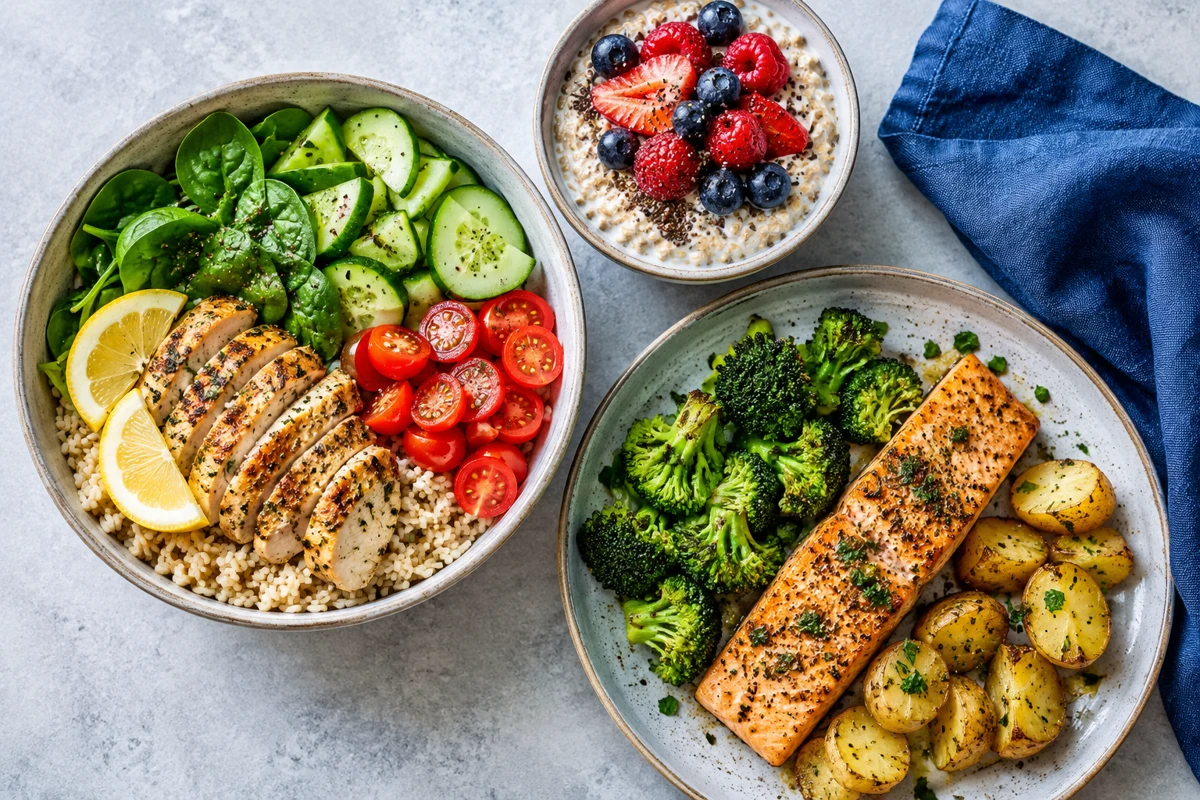
01 / PLAN YOUR PLATE
Choose any day to start. Swap days freely; open a meal for its recipe. Each recipe makes one starting serving. Add food or adjust portions to meet your needs; snacks are optional. Vegetarian swaps appear in every relevant recipe.
Monday
Apple + 1 tbsp nut or seed butter
Tuesday
Carrot sticks + ¼ cup hummus
Wednesday
Pear + a small handful of nuts or seeds
Thursday
Plain yogurt or fortified soy yogurt + berries
Friday
Orange + a small handful of nuts or seeds
Saturday
Edamame or hummus + cucumber
Sunday
Apple + cheese or a suitable dairy-free alternative
02 / MAKE SOMETHING GOOD
Simple ingredients, clear steps, and flexible swaps. Prep and cooking times are approximate; use temperature, not the clock, to check meat and fish.
14 recipes
Switch it up: Use a suitable soy yogurt for a dairy-free option.
Allergen notes: Milk; soy if substituted. Check oats for gluten cross-contact.
Switch it up: Use 150 g crumbled firm tofu in place of eggs; heat through.
Allergen notes: Egg, wheat; soy if substituted.
Switch it up: Use a protein-rich soy yogurt and pumpkin seeds instead of walnuts.
Allergen notes: Milk, tree nuts; soy if substituted.
Switch it up: Use sunflower-seed butter if suitable for your allergies.
Allergen notes: Wheat, peanuts, milk or soy.
Switch it up: Use ¾ cup chickpeas or 150 g firm tofu in place of chicken.
Allergen notes: Soy if tofu is used.
Switch it up: Use dairy-free yogurt and a gluten-free wrap if needed.
Allergen notes: Milk, wheat; check tortilla and yogurt labels.
Switch it up: Use white beans instead of lentils; choose gluten-free bread if needed.
Allergen notes: Wheat in bread; check broth ingredients.
Switch it up: Replace tuna with another ½ cup white beans.
Allergen notes: Fish, wheat.
Switch it up: Use 150 g firm tofu; roast until hot with browned edges.
Allergen notes: Fish; soy if substituted.
Switch it up: Use gluten-free tamari if required; replace tofu with cooked chicken if preferred.
Allergen notes: Soy, wheat in many soy sauces.
Switch it up: Replace turkey with ¾ cup extra beans for a vegetarian version.
Allergen notes: Check spice-blend labels.
Switch it up: Use chickpea or gluten-free pasta if suitable.
Allergen notes: Wheat; check alternative pasta labels.
Switch it up: Use ¾ cup black beans instead of chicken.
Allergen notes: Check tortillas and spice labels.
Switch it up: Use a regular potato or swap beans for lentils.
Allergen notes: Check salsa ingredients.
03 / MAKE THE WEEK EASIER
Use the recipe quantities for the days and servings you select. This checklist covers the base seven-day menu; add snack ingredients and any substitutions. Ticks stay on this page until you reload—it is not an account or saved shopping list.
Refrigerate perishable food within 2 hours, or 1 hour above 90°F. Keep the refrigerator at 40°F or below. Use refrigerated cooked leftovers within 3–4 days or freeze them sooner; do not hold a full week’s cooked meals in the fridge. Reheat leftovers to 165°F. Cook poultry to 165°F and fish to 145°F, checking with a food thermometer. Cook eggs until set.
Allergen notes are a starting point, not an allergen-free guarantee. Check every package and avoid cross-contact. Substitutions change nutrition. If you need a renal, diabetes, pregnancy, allergy-specific, or other medical diet, adapt the plan with a qualified professional.
04 / TRAIN WITH A PLAN
Plan for three strength sessions: Monday, Wednesday and Friday. Add an optional fourth cardio workout on Saturday. Alternate A/B/A one week and B/A/B the next, with at least a day between strength sessions. New to training? Build up to this schedule at your own pace.
First two weeks: try one set per exercise, with a resistance that leaves about 2–3 good repetitions in reserve. The sessions below show a two-set progression. Move slowly, breathe throughout, and avoid training to failure. Ask a qualified trainer to check unfamiliar movements.
Warm up for 5 minutes with easy walking or cycling, then practice the first exercise without load. Rest 60–90 seconds between sets, longer if needed. Finish with 3–5 minutes of easy movement.
Stand in front of a stable chair, feet hip-width. Sit back, touch the seat and stand. Keep knees tracking with toes.
Make it easier: Use hands on chair arms; stand from a higher seat.
Place hands on a fixed surface, keep body straight, bend elbows and press away.
Make it easier: Use a wall instead of a counter.
Support one hand on a sturdy surface. With a light dumbbell, pull elbow toward hip; lower slowly without twisting.
Make it easier: Practice the motion without a weight.
Lie on your back, knees bent, feet planted. Squeeze glutes and lift hips gently; lower with control.
Make it easier: Use a smaller lift or standing glute squeezes.
Lie on back with knees bent above hips. Lower one heel toward floor, keeping ribs and pelvis still; alternate.
Make it easier: Keep one foot on the floor and slide the other heel.
Hold a stable support. Rise onto toes, pause, and lower slowly.
Make it easier: Use a smaller range.
Warm up for 5 minutes with easy walking or cycling, then practice the first exercise without load. Rest 60–90 seconds between sets, longer if needed. Finish with 3–5 minutes of easy movement.
Hold a fixed support, take a staggered stance and bend both knees slightly. Press through front foot to stand.
Make it easier: Repeat chair squats instead.
Keep knees soft, push hips back with weights near thighs, then stand tall. Keep back neutral.
Make it easier: Practice an unweighted hinge toward a wall behind you.
Keep body straight and shoulders away from ears; lower toward support and press back.
Make it easier: Stand closer to a wall.
Support torso with one hand. Pull a light weight toward hip without rotating.
Make it easier: Use no weight while learning.
Sit or stand tall. Press light weights overhead only through a comfortable range; avoid arching.
Make it easier: Use wall slides without weight; omit if painful.
From hands and knees, reach opposite arm and leg without shifting hips; return slowly.
Make it easier: Lift only an arm or slide one leg back.
Warm up for 5 minutes with easy walking or cycling, then practice the first exercise without load. Rest 60–90 seconds between sets, longer if needed. Finish with 3–5 minutes of easy movement.
Set seat so your lower back stays supported. Push through whole feet; stop before locking knees.
Make it easier: Use light resistance and a comfortable range.
Set handles near mid-chest. Keep back supported; press out and return slowly.
Make it easier: Reduce load; ask staff to adjust seat.
Sit tall and pull handles toward lower ribs. Avoid leaning backward.
Make it easier: Use lighter resistance.
Align the machine pivot with your knee; curl slowly and return with control.
Make it easier: Ask staff to adjust pads; use light load.
Stand side-on to a light cable at chest height. Press hands forward without rotating; return.
Make it easier: Stand closer to the anchor and lower load.
Hold support, rise onto toes, pause and lower.
Make it easier: Use body weight only.
Warm up for 5 minutes with easy walking or cycling, then practice the first exercise without load. Rest 60–90 seconds between sets, longer if needed. Finish with 3–5 minutes of easy movement.
Hold a light dumbbell at chest. Sit back toward a stable bench, touch down gently and stand.
Make it easier: Use body weight or leg press.
Soften knees, slide weights down thighs while hips move back. Stand by driving hips forward; do not round back.
Make it easier: Ask a trainer to teach the hinge; use an unloaded version.
Lie on a low-incline bench; press light weights over chest and lower with control.
Make it easier: Use seated chest press.
Pull bar in front toward upper chest, keeping torso steady. Return slowly.
Make it easier: Use lighter resistance; never pull behind neck.
Keep ribs down and press only through a comfortable range.
Make it easier: Use unweighted wall slides or omit if uncomfortable.
Lie on back; alternate lowering one heel while keeping pelvis still.
Make it easier: Slide heels with both feet starting on floor.
Begin and end with a few easy minutes. In the middle, walk at a pace where you can still talk. Split the session into shorter walks if that fits your day. A stationary bike or comfortable water exercise can substitute.
Start with 2 minutes of easy marching. Then try 6 shoulder circles each way, 6 gentle standing upper-back rotations per side, 8 ankle rocks per side while holding support, and 6 unweighted hip hinges. Repeat at an easy pace. Stay in a comfortable range; do not force a stretch.
These routines are general adult fitness guidance, not rehabilitation or medical clearance. If you are pregnant, have an injury or medical condition, or experience treatment-related symptoms, ask your clinician which activities fit. Stop for pain, dizziness, or feeling unwell; seek urgent help for chest pain, fainting, or severe breathing difficulty.
Mayo Clinic: strength-training technique and recovery
05 / BUILD THE HABIT
Building your routine? Explore MB POWER creatine and ION Recovery. Supplements are optional; start with consistent training, food, and recovery.
Build toward Monday, Wednesday and Friday strength sessions, starting with one set per exercise. Use A/B/A in week 1 and B/A/B in week 2. Start with fewer sessions if needed while you learn the movements and assess recovery. Keep Saturday cardio optional.
Continue alternating A/B/A and B/A/B. If recovery and technique are good, move toward two sets per exercise. Add the optional Saturday cardio session when it fits your recovery. Increase either resistance, sets or cardio time gradually—one change at a time.
Write down the date, exercise, resistance, sets, reps, and how the session felt. For meals, note which recipes you enjoyed, preparation time, hunger, and any symptoms to discuss with your clinician. Progress can mean easier movement, consistency, or better technique—not only a number on the scale.
Food, activity, sleep, and recovery come first. MB supps may help fill an individual nutrition gap or make your routine convenient. A multivitamin does not replace a varied diet; protein powder is optional. Check labels, allergens, and stimulant content, and review supplements with your clinician before combining them with treatment.
Explore daily vitamins, protein & moreDiscuss persistent nausea, vomiting, dizziness, difficulty eating, or dehydration with your treating clinician. They can help adapt meal size, hydration, protein intake, and activity. This guide does not set medication doses or replace your care plan.
YOUR WELLNESS TOOLS
Ask SARAH about your workout, meal ideas or everyday habits. Follow up, swap an exercise, or explore the free guided tools. No signup required.
Chat with SARAHRecipes and workout examples are original Men’s Blue site content. General activity, meal-planning and food-safety principles draw on the sources below; these organizations have not endorsed this guide.
Updated October 4, 2026.
Medical & laboratory information